Media Nation has moved!

You should be automatically redirected in 6 seconds. If not, visit
http://www.dankennedy.net
and update your bookmarks.

Tuesday, July 31, 2007

The Methodists' anti-Israel campaign

Michael Paulson reports in the Globe that the New England Conference of the United Methodist Church is urging fellow Methodists to divest from companies that are supporting the Israeli occupation of Palestinian territories.

The Methodist statement begins even-handedly enough:
Despite renewed talk of peace between Israelis and Palestinians, the hard reality is that Israel's actions on the ground in the region, as well as Palestinian militant attacks on Israelis, place enormous obstacles in the way of progress toward peace.
So why does the conference propose punishing Israel alone? This is nasty business. Someone should ask Hillary Clinton, a Methodist, where she stands.

Labels:

Those golden days of last Thursday

Today's Globe editorial on Middleborough keeps the string alive — there's no mention of the second vote, to reject the casino itself. But if you look back to those golden days of, oh, last Thursday, you'll see that at least one Globe reporter thought the second vote was very important indeed.

In a preview of the Middleborough town meeting for Globe South, Christine Wallgren wrote:
The first of the two ballot items authorizes selectmen to enter into an already-negotiated agreement with the Mashpee Wampanoag and their backers to build a casino complex.

The second item — placed on the warrant by the casino opposition — asks voters whether they want a casino built in town at all. While it is nonbinding, casino opponents hope a negative vote will show state and federal authorities that a casino is not welcome under any terms....

Rejection of the idea of a casino in town would send a message to state and federal officials who must act on other aspects of the tribe's casino proposal.

"This way, people get to actually vote on whether they want a casino, rather than just voting on a flawed agreement," said casino foe Richard Young. "This would send a message to the selectmen, and I think at least some of them would take it to heart. They could fight this. Other towns have fought and won."

Another casino foe, Jacqueline Tolosko, said: "I've been told by [state] Senator Marc Pacheco and by [US Representative] Barney Frank that if residents of this town don't want a casino, they will back us. I think the vote on this is very important."

Opponents have said they hope a negative vote would have some impact on how state and federal authorities react when the tribe looks to put the land in trust and obtain a compact for expanded gambling.
Exactly. So why does the Globe continue to ignore this important wrinkle? Last Thursday, Wallgren got the nuances right: the first vote was on the agreement with the Wampanoags; the second vote was on the casino itself. Today's editorial blasts past all that. When is the Globe going to get it right?

Labels: , , ,

Monday, July 30, 2007

Cleaving unto absurdity

I couldn't believe it when John Harwood, on "Meet the Press," defended that ridiculous Washington Post column about Hillary Clinton's alleged cleavage on the grounds that she's too "calculating" not to know what she was doing. So I'm glad that Media Matters was similarly appalled.

Labels: , ,

"Middleboro's Nosy Neighbor"

"Gladys Kravitz" is a hoot, but she can sting, too. Here she is on casino proponents who supposedly mocked Jacquie Tolosko, leader of the anti-casino group CasinoFacts.org, when she became emotional:
It's difficult for me to comprehend what kind of sociopathic low-brow trailer trash would do that sort of thing to a person so courageous as to stand before three-thousand strangers and speak from the heart, but clearly they're charter members of that same sad deluded faction which actually believes a casino is their friend.
Kravitz has a warning for the media as well, writing that "it's apparently going to be up to us to get the word out about the NO vote, because the Fourth Estate seems to have taken a vacation day."

Labels: ,

A reporter's best friend

Jeff Keating, writing for the Greater Boston Blog, makes a terrific find — Government Center, a collection of computer-assisted-reporting (CAR) resources at Boston.com. I especially like the Dunkin' Donuts finder. But seriously — this is great stuff, and I'll add it to the list of resources I give my students.

Here are a few of Media Nation's favorite CAR sites:
Have any I should know about? Please pass them along.

Labels:

Put those shovels down

The most complete story on what comes next for Middleborough is this one, which appears in the Cape Cod Times and The Standard-Times of New Bedford. Obviously there's a long way to go before anyone breaks ground on a casino. Reporters Curt Brown and Don Cuddy write:
Despite the overwhelming vote in favor of a casino, [casino opponent Richard] Young said he feels the public expressed its true sentiments Saturday when it rejected a nonbinding question to approve casino gambling in town.

But only about half the voters were still at town meeting when the nonbinding question was decided.
True, but as I have already explained, that doesn't negate the validity of the question. And half of nearly 4,000 is still a huge turnout for a town meeting. Sabutai comes through again in a comment on Blue Mass Group, placing in their proper perspective the "yes" vote on Article 2, to approve the agreement with the Wampanoags, and the "no" vote on Article 3, to reject the casino itself (bolds are his):
I realize there is an interest in spinning the votes on 2 and 3 to undercut questioning of the result. The media has embraced the spin of the town officials and the pro-casino side. Fact is, having some 1,500 people vote on a question is probably the second-highest total in Middleborough history. Given that the third article pre-dated the second and was submitted by petition, it's interesting that it was relegated to "garbage time". Again, the interests of the Tribe came before the interests of the citizen of Middleboro. I'm not expecting that the votes wouldn't be close on those two articles considering how the town was divided, but they should at least be consistent. The fact that the votes were not indicated the failure of this meeting.
Speaking of spin embraced by the media, the Globe today still can't bring itself to mention the "no" vote on Article 3. What is going on over there?

Finally, here is what Casinofacts.org, the anti-casino group, is saying about Saturday's vote:
Middleboro says "Yes" and "No"

The article to enter into an agreement with with Tribe passed. The article about whether or not people wanted a casino did not pass. I think this is very telling on the effect of "vote yes or else".

So Middleboro said "Yes" to an agreement(or else) and "No" to wanting a casino.

Now that the vote is over, we'll be taking a few weeks to catch up on work, home, family and decide what the next steps will be.

I'm not going to stop posting on this, but I am going to turn it down to a slow simmer, and keep watching as the story unfolds.

Hilarious. A Media Nation reader passes along this e-mail from Stephen, a downtown lawyer: "So when is Middleboro going to change its name to John Kerry Ville? (We voted for the casino before we voted against it.)"

Labels: ,

Sunday, July 29, 2007

The Globe's stunning omission

I'm stunned that the Globe failed to report that Middleborough voters, shortly after approving the agreement with the Wampanoags, turned around and rejected the casino itself. Despite publishing two stories (here and here) featuring four bylines, the paper somehow couldn't find an inch to include that crucial fact. The Globe managed to do better in its online coverage yesterday. And as I've already noted, the Herald gets it right in its own Sunday story.

So, for that matter, does The Standard-Times of New Bedford, whose deep reporting on yesterday's proceedings shows that this fight is a long way from being over. First, consider this, from Steve Decosta's story:
After casting their votes on the agreement and before the final tally was announced, the body, on a hand vote, ironically rejected a nonbinding question to approve casino gambling in town. Only about half the voters remained on the high school athletic field for that tally.

"I don't think that's a true indication of how people feel, because so many people had left," said Marsha Brunelle, selectmen chairwoman.

Asked if that outcome tainted the vote on the agreement, Mr. Marshall [Glenn Marshall, the Wampanoag chief] said: "It's the end of a hot day, people get tired, people leave. The true number is the one that got counted."

But casino opponents would not minimize their victory.

"That's the root question," said Jacqueline Tolosko, president of the anti-casino group Casinofacts. "We're really encouraged. The town just said it doesn't want a casino. How can that not have weight?"
Think about the cluelessness of Brunelle's comments. Only 25 percent of the town's registered voters took part in approving the agreement with the Wampanoags. As has been meticulously and widely documented, turnout was held down because of the midsummer heat and humidity, which kept elderly residents and people with health problems away. People who had to work or who couldn't find child care were kept away, too.

As for people leaving, well, town officials all but told people to leave by staging a disgraceful signing ceremony with the Wampanoags as soon as the agreement was approved, but before the casino itself was put to a vote. [Well, no. See correction, below.] That action in itself ought to be the subject of a legal challenge on the grounds that it was a ruse aimed at making people think the meeting was over.

Even so, the vote to reject the casino was a legal (if non-binding) vote on a warrant article properly put before town meeting. Officials have no right to pretend that vote never took place. Again, think about Jacqueline Tolosko's remarks: "The town just said it doesn't want a casino. How can that not have weight?"

The second Standard-Times story, by Steve Urbon, expands on Sabutai's report about improper influence on the part of casino proponents. Look at this:
Another opponent, Richard Young, pointed to Bill Marzelli and his dozens of orange-shirted casino backers and complained that while they were allowed to wear the T-shirts and white hats that read, "Vote YES for Middleborough's future," the police confiscated his side's yellow leaflets, which explained a few opposition talking points. "I'm not allowed to give you anything to read," he said.
Do I need to point out that the town's two police unions have endorsed the casino? This strikes me as sufficient in and of itself to throw out the results of yesterday's vote. No wonder police didn't want the media watching.

Let me expand on something I wrote earlier. No doubt some people voted "yes" on the agreement because they would genuinely like to see a casino come to Middleborough. But there were others — plenty of others, I suspect — who voted "yes" because they were told, repeatedly, that the casino was coming whether they wanted it or not, and that they might as well negotiate the best terms that they could.

Last week, New England Cable News' "NewsNight" program devoted a half-hour to the Middleborough debate. In the first segment, Ted Eayrs, a town assessor and former selectman, debated Greg Stevens, a casino opponent. In the second, I debated town planner Ruth Geoffroy, who favors the casino.

If you watch both segments, you will see that Eayrs (an opponent until recently) and Geoffroy each talked repeatedly about the supposed inevitability of the casino as a reason for approving the agreement. Let me share something else with you that you will not see in these segments: As we were leaving NECN, Eayrs told me that though he favored the agreement as the best way of protecting the town's interests, he hopes the state will step in and stop the casino from ever being built.

Well, gee, that's exactly how Middleborough residents voted yesterday, isn't it? "Yes" on the agreement, "no" on the casino itself.

Gov. Deval Patrick will have a major say in what happens next. Without his wholehearted approval, a casino will not be coming to Middleborough. The governor needs to consider the fact that voters yesterday said "no" to the casino. Patrick should say no, too.

Update: This is really incredible. The Globe runs a slideshow of supporters and opponents of the casino — and the first two are of supporters wearing orange shirts! The message is cut off, but the first guy is also wearing a white cap that says "Yes to Middleborough's Future." Remember, the opponents' leaflets were seized by police.

Update II: NECN gets it right. This report is particularly good on how opponents were marginalized and shunted aside. It also mentions the "no" vote on the casino itself.

Correction: According to this story, in the Cape Cod Times, the vote on the casino itself was held while the ballots on the casino agreement were being counted. WBUR Radio reports it the same way. That's a significant difference, and I regret the error.

Labels: , , , ,

"Overwhelmingly defeated"

Laura Crimaldi's story in the Sunday Herald says that the casino was "overwhelmingly defeated" when it was finally put to a vote. This despite the fact that Middleborough officials were so disrespectful of the process that they staged a signing ceremony after the agreement with the Wampanoags was approved, but before the non-binding advisory question on the casino itself was put to the voters. No wonder people left early.

Sabutai's account says that the show-of-hands vote on the casino was "much closer" than an earlier vote to cut off debate, but he doesn't say how close. No doubt accounts will differ. I hope we see something more definitive. Not that the margin matters, but, symbolically, it would be helpful if everyone understands that people voted against the casino.

"When they got to vote their conscience, they did that," casino opponent Richard Young is quoted as saying in Crimaldi's account.

I love the way Sabutai ends: "The ball is in the General Court. May they prove to have more wisdom than the selectmen of Middleboro, more patience than its people, and more temperance than its moderator."

Labels: ,

Saturday, July 28, 2007

Local newscasts skip second vote

Just caught the top of the 11 p.m. news on Channels 4, 5 and 7. I was flipping around, so it's possible that I missed it. But it didn't appear that any of the three reported on the second, anti-casino vote. Shoddy.

On the other hand, kudos to Channel 5 for doing a sidebar on people who couldn't make it to the town meeting today — not just elderly voters, but folks with respiratory problems, people who had to work and parents who couldn't arrange for child care (kids weren't allowed).

This is democracy? No. It isn't.

Labels: ,

Middleborough voter explains all

Here's a pretty powerful anecdote suggesting that people in Middleborough knew exactly what they were doing when they voted in favor of the casino agreement but against the casino itself. From the Associated Press:
A sense of resignation that a casino was a done deal drove the decisions of several voters interviewed as they walked into the meeting.

Michelle Holden, 45, planned to reluctantly vote for a casino deal she called inevitable. Regardless of Saturday’s vote, the tribe owns the necessary land and can build so long as it secures federal and state approval, she said.

If nothing else, Holden hoped the extra revenue could help the town restore services it previously cut, like freshman sports for her 16-year-old son.

"I don't really want the casinos here, but it's coming," she said. "We might as well benefit through the town."
Over at Blue Mass Group, you'll see arguments that the "no" vote on the casino itself doesn't mean much because people were leaving at that point, because the vote was taken by a show of hands, because the town moderator's visual acuity was wanting, because the vote was non-binding, etc., etc. Even Sabutai makes those points. I'm not saying he's wrong — I'm saying it's irrelevant. The vote was the vote, and it is perfectly reflected Holden's sentiments.

It's sad that people like Holden have come to believe that the fight is lost already, and that the best they can do is negotiate the most favorable terms of surrender. You can always fight. You can go to court. You can lay down in front of the bulldozers.

But the inevitability of the casino is the prime message being pushed by the cynical casino proponents. Don't believe it.

Labels: , ,

Middleborough rejects casino

Despite all the propaganda, despite the loathsome efforts of casino supporters to cast opponents as friends of the Ku Klux Klan, Middleborough residents today did the right thing and said "no." Keep that in mind when you hear that folks who attended the town meeting approved the selectmen's proposed deal with the Wampanoags. To wit:
  • The Enterprise: "After a grueling four-hour town meeting in more than 90 degree weather, more than 3,000 voters at today's historic town meeting voted overwhelmingly to accept the agreement to put a casino in town."
  • The Globe: "Voters in Middleborough today approved a historic agreement to bring a casino to the semi-rural town 40 miles south of Boston."
  • The Herald: "Middleboro OKs casino by 2,387 to 1,335."
So, is Media Nation hallucinating? Not at all. Here is the key, explained farther down in the Globe story:
The voters, however, sent a mixed message. In a separate, non-binding question before the town meeting, the residents voted no on a proposal to have a casino in the town. Town officials insisted that the open ended question — approved by a voice vote — had no impact on the agreement with the Wampanoags. But casino opponents were nonetheless cheered by that result.
That is not a mixed message at all. That is a clear message that though the voters believed the proposed deal was the best they could get, their preference is no casino at all. Over and over, the townspeople have been told that if they rejected the deal, the casino would be built anyway, and the town would get far less than it would by signing the agreement. Thus the "yes" vote on the agreement was entirely predictable.

But they rejected the casino itself, and that ought to be the end of it. It will be interesting to see how the pro-casino forces spin this one. I just hope the media catch on better than they have so far.

Update: Here is the warrant for today's town meeting. As you can see, Article 2 was on the agreement, and Article 3 was on the casino itself. Here's what voters said "no" to in Article 3: "To see if the Town approves of the creation of a Gambling Casino Resort Complex within the Corporate Boundaries of the Town, or act anything thereon." Clear as a bell.

Update II: Great report from Sabutai at Blue Mass Group. Check out his description of orange-shirted, pro-casino union forces, who pushed their way into the crowd and apparently even managed to cast some voice and hand votes. The "yes" vote should be challenged immediately because of this shocking breach of protocol. Remember, town police took some pains to keep the media at bay — why couldn't they do the same to the IBEW?

Labels: ,

Friday, July 27, 2007

On the map

The New York Times today has a good and important front-page story on how simple mapping tools offered by Google and Yahoo! are changing the way we communicate. If you want more, Wired went deeper last month.

The revolution in free, Web-based software tools is astounding. Less than a year ago, when I showed my students mash-ups such as ChicagoCrime.org and this Boston.com mash-up of political contributions in the governor's race, the likelihood of a non-programmer pulling off such a feat seemed nil. Now anyone can do it, and publish the results to the world.

Labels: , ,

Is Botsford in trouble?

The Herald's Laurel Sweet reports that Gov. Deval Patrick's nominee for the Supreme Judicial Court, Superior Court Judge Margot Botsford, has some pretty close political ties to the governor: Her husband, Boston lawyer Stephen Rosenfeld, was so enthusiastic about Patrick's gubernatorial campaign that he donated three times the legal limit.

Botsford is well-qualified and progressive, but this has the aroma of a quid pro quo. You could argue that she's not responsible for her husband's political donations, but come on. As a judge, she can't make political donations anyway. (Or at least she shouldn't.) And why didn't someone at the Patrick campaign flag the excess donations and return them?

Rosenfeld was a top aide to Michael Dukakis when he was governor, which gives Herald columnist Howie Carr an excuse to stroll down memory lane.

This strikes me as being on the line. It could go away quickly, or it could blow up into yet another Patrick kerfuffle — especially if the Globe's new metro editor, Brian McGrory, is upset enough about getting beat on this.

Labels: , , ,

Outdoors in the dark

Middleborough officials have decided to keep the media far, far away from tomorrow's fiasco of a town meeting, which is expected to draw as many as 10,000 people to the high school. Here is the complete text of a media advisory issued yesterday by the Middleborough Police Department:
MEDIA ADVISORY:

July 26, 2007

CONTACT:

Middleborough Police Department

Attn: Lt. David Mackiewicz

Fax Number: (508) 947-1009

Middleborough Special Town Meeting - Casino Decision

On, Saturday July 28, 2007 at 11:00 a.m. the town of Middleborough will be conducting a Special Town Meeting at the Middleborough High School at 71 East Grove Street in Middleborough (Route 28). The purpose of the meeting is to determine the residents' position regarding the recently negotiated Wampanoag Casino agreement.

To ensure the event receives proper media coverage and only registered voters are allowed to vote specific control measures will be in effect for all media outlets attending the event.

Press Rules

1. Venue: The Town of Middleborough will be conducting a Special Town Meeting for the purpose of deciding the residents' position regarding the recently negotiated Wampanoag Casino agreement.

2. The meeting will occur at the Middleborough High School on Rt. 28, at 71 East Gove Street, Middleborough, Ma.

3. The meeting area will be restricted to only Middleborough registered voters. Invited guests will be authorized only as specified by the Town Moderator.

4. Media personnel will be authorized access to view the event from a designated media area.

5. Application for Media Parking Passes: Fax all requests for media vehicle parking passes to the Middleborough Police Department, 508-947-1009, Attn: Lt. David Mackiewicz NOT LATER THAN 3:00 PM on FRIDAY, July 27, 2007. Space is limited and Media Parking Passes will be limited to two passes per media outlet. Media Parking Passes will be returned by fax to your media outlet and must be presented to gain access to the designated media area.

6. Media will be required to arrive between 06:00 AM and 07:30 AM on Saturday, July 28, 2007. No new media personnel will be allowed entrance after 7:30 AM on Saturday, July 28.

7. Voting residents will begin arriving at 08:00 AM. Media will be allowed an interview area where they can conduct interviews with voting residents inside the designated media area between 08:00 AM and the start of the meeting. The meeting will begin at 11:00 AM.

8. A MALT box ["a piece of equipment that allows reporters to plug in audio equipment to record directly from the sound system"] will be available in the designated media area for media use.

9. Media will not be allowed to leave the designated media area until the meeting is adjourned.
This is going to be a zoo (albeit an unnecessary zoo, and one of town officials' devising), and obviously some measures are needed to keep things under control. But these restrictions are so tight that you have to wonder if reporters are going to be able to tell what's going on, or will instead have to try to reconstruct events after the fact.

Will the sound system truly be audible? Will speakers from the floor (excuse me, the grass) be properly patched in to the sound system? Will some provision be made to identify speakers (a notorious problem in covering any town meeting)? Why on earth do all reporters — even lowly print reporters carrying nothing but a pen and a notebook — have to arrive by 7:30 a.m. if the meeting doesn't start for another three and a half hours? What is #9 about? Surely folks can leave, can't they? What about a photographer with an early deadline?

For that matter, why does Middleborough need more security than the Democratic and Republican national conventions?

Meanwhile, in today's Globe, Sean Murphy and Christine Wallgren report that town officials' dreams of $4 million a year in hotel-tax revenue are just that — dreams. And here is the text (PDF) of the study-committee report the Herald mentioned yesterday — the one that found suicide rates will increase, but, overall, the casino will be a good thing. You can't make this stuff up.

Finally, NECN has posted the video of our discussion on "NewsNight" last night.

Labels: ,

Thursday, July 26, 2007

Make news, not views

My latest commentary for the Guardian is up. In it, I use the occasion of Paula Zahn's departure from CNN to take a look at why there's no news on cable news these days, especially in prime time.

Labels: , , ,

Examining the New England News Forum

My media column in the new issue of CommonWealth Magazine takes a look at the New England News Forum, a nascent organization based at UMass Amherst that's modeled after — and, in important ways, not modeled after — the news councils of Minnesota and Washington State.

"We are not a watchdog group if the watchdog's role is to go bite the mailman," says Bill Densmore, the director and editor. "It's to assess the mailman and educate the dogs about the mailman's role."

Labels: ,

More reasons to reject the casino

Is State Treasurer Tim Cahill a friend of the Ku Klux Klan? No doubt his opposition to the casino in Middleborough will be cast by proponents as biased, given that Cahill wants the state to build its own casino. But Cahill's assessment that the casino would be a bad deal for the town — reported in today's Globe by Andrea Estes — should be taken seriously. Cahill tells Estes:
It will change the entire fabric of the community, but it's the tribe and the investors who will make the lion's share of the money. There are a lot of holes in the agreement. I don't see where it helps the town financially.
Is the Middleboro Casino Gambling Study Committee a friend of the Ku Klux Klan? According to the Herald's Mike Underwood, the committee has concluded that a casino could "increase suicides, bankruptcies and trigger an exodus of residents," as well as lead to choking traffic increases on Route 44.

Oh, but there's good news, too — there would likely be no "direct" increase in crime as a result of the casino's being built. Never mind that there would be a huge indirect increase, as documented by the Globe last Sunday in a report on what happened to the communities around Foxwoods and Mohegan Sun.

Are officials from 15 cities and towns surrounding Middleborough friends of the Ku Klux Klan? Theresa Knapp Enos reports in the Enterprise of Brockton that those officials will meet tonight in Lakeville to discuss the impact of the casino in their communities. Of course, they don't get to vote in the Saturday town meeting. Enos writes:
[Bridgewater] Selectman Mark Oliari, Bridgewater's liaison with the town of Middleboro, reported to fellow board members at the selectmen's meeting on Tuesday that there are "serious issues," such as traffic, decreased local aid from Lottery receipts and additional school resources.
Think about it. The Lottery is going to take a terrible hit if casino gambling comes to Massachusetts (which is why Cahill wants the state to grab a piece of the action). Traffic will become a nightmare throughout the region, but the Wampanoags propose only to upgrade roads in Middleborough. And, of course, the low-paid casino workers who would move to the area will put a strain on school systems throughout the region, not just in Middleborough.

This is a disaster in the making. As Sabutai writes at Blue Mass Group: "I'm not sure if I'm naive to hope that the state government would not greenlight a massive project within a town where the residents offered a resounding 'no', but I'd hope that a 'no' on Saturday will end the debate in this town at least. New Bedford and Boston would looooove a casino. Wouldn't you rather work with people who want you?"

I'll be debating the casino today at 7 p.m. on New England Cable News' "NewsNight."

D'oh! The Enterprise was previewing a meeting that has already taken place. Here's an account in today's Globe, by Christine Wallgren. Great quote from Halifax Selectman John Bruno about Middleborough Selectman Adam Bond, a casino supporter: "I appreciate Mr. Bond's attempt to help his community, but I also appreciate that selling your soul for money is never a good idea. This does not belong in Southeastern Massachusetts."

Labels: ,

Wednesday, July 25, 2007

Don't ask, don't tell

Media Nation regular O-Fish-L passes along a curious item. It seems that Patriots linebacker Tedy Bruschi was rumored to have died during the past day or so. Mr. Fish writes: "Now I've called the Herald, Fox 25 and WEEI to check on this. All three had heard the rumor and quickly dismissed it as false. Someone at Fox told me that Bruschi's agent asked them not to run a story dispelling the rumor because it might adversely affect the Bruschi children."

Obviously this was not a particularly outlandish rumor, given Bruschi's stroke history. Fortunately, he is alive and well.

Anyway, it appears that the first person to make any public mention of this story was Tom Curran, who posted a blog item at NBCSports.com — and Curran whacks the media, writing:
How did it get this far? Well, the answer won't really drape the journalism industry in glory.

Apparently, an anonymous e-mail to a TV affiliate in Boston came in Monday afternoon saying that Bruschi had gone to Jesus.

Before getting confirmation from the Patriots that Bruschi was (and is) indeed alive, the rumor made its way to other media types putting them on red alert as well. This caused them to start calling every contact they could to find out if tragedy had struck Bruschi and the Patriots again. And they called two friends and so on, and so on.
So reporters aren't supposed to ask questions? Isn't that what we do? It would have been disgusting if someone had put out an unconfirmed report that Bruschi had died, but no one did that. And it was Curran, after all, who broke the so-called news that this rumor was circulating.

Mr. Fish adds: "Trust me when I tell you that this one had legs and caused more panic than the 'Great Blue Hill Volcano' from April Fools Day many years ago. I heard it from my elderly mother, to a police Lieutenant that I once served with, to a clerk at the corner store. It seems Curran is the only journalist to officially touch the story thus far."

I can't imagine why Curran thinks it's wrong for any journalist to check out a tip, verify that it's not true and then not report it.

Following Curran, WCVB-TV (Channel 5) confirms Bruschi's continued status as being among the living.

More: Bruce Allen explains. (Via Universal Hub.)

Labels: ,

Tuesday, July 24, 2007

A better YouTube debate

May I make a confession? I completely forgot about last night's Democratic debate, and thus missed the two-hour exercise in YouTube-fueled citizen participation.

But I can definitely see both sides regarding the one controversy the format engendered: CNN's decision to handpick the questions rather than let the YouTube community vote on them. The chances of campaign workers' monkeywrenching the results were high. On the other hand, if CNN is going to pick which questions it wants the candidates to be asked, it might as well let Anderson Cooper ask the questions.

David Bernstein of the Phoenix writes that CNN "pretty much created a TV show out of the free raw video materials, not entirely unlike an episode of America's Funniest Home Videos." He's right.

So here's an idea that might work. Let CNN pick six or seven (or 10) broad categories that it wants to put to the candidates. Let the YouTube community vote on the best question in each of those categories. Questions that mention any candidate by name can be thrown out. What do you think?

Over at YouTube today, you can watch the debate, question by question, and post your own video response.

Labels: , ,

Just say no to the casino

One of the very first things you see when you visit Casino-friend.com — a Web site started by supporters of the proposed Middleborough casino — is an insinuation that casino opponents are in league with the Ku Klux Klan. The site touts an "editorial" calling on an anti-casino group, Casinofacts.org, "to repudiate bigotry, prejudce and hate and any connection with a national group called by a major Indian magazine 'The Ku Klux Klan of Indian country.'"

Guilt by association, a demand to repudiate something that has nothing to do with the honest efforts of folks who don't want to see their town destroyed — oh, yes. It's obvious that the pro-casino forces will stop at nothing. Money doesn't talk, it screams.

I grew up in Middleborough. I moved away many years ago, and thus cannot claim to be a stakeholder in this debate. But there's really no question about what the impact will be if this monstrosity ever gets built:
  • The rural character of the town will be destroyed forever.
  • The highways and roads will be choked with traffic.
  • Crime and police activity will increase significantly, as the Globe reported on Sunday.
I hope the casino gets voted down at the special outdoor town meeting that's been called for this weekend. But if it passes, I hope Gov. Deval Patrick slams on the brakes. A casino would severely harm the quality of life in Middleborough for generations to come. A chaotic public gathering, held just a few days after the agreement between town officials and the Wampanoags was made public, is no way to resolve this. I also question whether even a majority should have the right to do this to fellow townspeople.

The best way to resolve this is to kill it now.

Labels: ,

Monday, July 23, 2007

Young people and the news

I'm putting this out to my ever-helpful readers: Do you know of any worthwhile efforts on the part of news organizations, either mainstream or alternative, to get young people engaged with the news? I'm talking about hard news and public-service journalism. Any and all leads and suggestions will be appreciated it.

Labels: ,

On top of the world

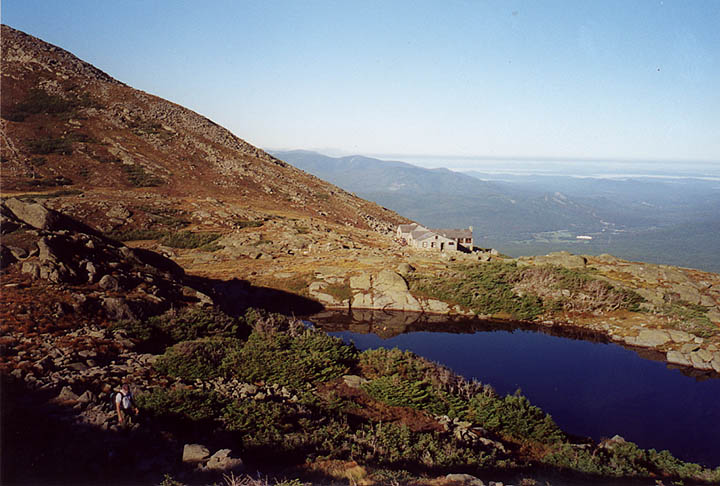
Right around lunchtime on Saturday, Sept. 28, 1968, I struggled to the top of Mt. Pierce, also known as Mt. Clinton. I was a 12-year-old Boy Scout, out of shape, out of breath, wondering what I'd gotten myself into.

At 4,310 feet in elevation, Pierce was the first 4,000-foot mountain I had ever hiked; for that matter, it was the first mountain of any size whose summit I had reached. By the end of the day, I would also hike to the top of Mt. Pleasant (now Mt. Eisenhower). We camped at Lakes of the Clouds, an activity that, because of the fragile alpine vegetation, would become a federal crime within a few years. The next morning, beset by clouds, wind and rime ice, we struggled to the top of Mt. Washington (6,288 feet), the highest peak in New England and home to what is often described as the worst weather in the world.

Once I got over my never-again reaction, I was hooked. I learned that there are 48 peaks in New Hampshire of 4,000 feet or more, and that a few serious hikers set out to reach them all. I plugged away, hitting a lot in the '70s and a few in the '80s and '90s. Starting in 2000, when my son, Tim, was old enough to come with me, I resolved to finish the list before I was too old and decrepit to do it anymore.

This past Saturday, just shy of my 51st birthday, I made it. It took me nearly 39 years, which might be some sort of a record — albeit a very different record from the one set by an ultramarathoner named Tim Seaver a few year ago. Seaver did all 48 mountains in less than four days.

My son and I drove to Lincoln, N.H., on Friday, and set up camp at Big Rock. It rained all night, which made me wonder about the forecast of blue skies for Saturday. As it turned out, the weather was almost perfect — cool and not too sunny, if a bit on the humid side. We started out along the Hancock Notch Trail, from the Kancamagus Highway, at 9:30 a.m. The footing was flat and easy, and by a little after 11 we had reached the split on the Hancock Loop Trail, which would take us to the north and south peaks of Mt. Hancock — summits number 47 and 48.

Which one to take first? The hike up the north peak was a bit longer (0.7 mile as opposed to 0.5), and also steeper, with rougher footing. Tim and I decided to go up the north side so that we wouldn't have to hike down it and risk our necks. It turned out to be a good decision — there was a lot of loose rock, and there's no way we would have wanted to try to descend along that route.

The hike to the top was pretty much straight up, and we had to pause frequently to catch our breath. We reached the summit around noon. There was a great view from the nearby outlook, and I wish we'd stayed longer. But I wanted to make it to my final summit as soon as possible.

We hit the summit of the south peak right around 1 p.m. I'd done it. It was also Tim's 17th 4,000-footer, so he's well on his way. A guy from Worcester named Steve, who was hiking with his girlfriend and another couple, took our picture. Steve, who's also 51, has 47 summits under his belt, and is planning to make it to number 48 — Mt. Isolation — next weekend.

We made it back to the car before 4 p.m. and headed off to the Yankee Smokehouse. And thus ended a journey that took in parts of five decades. I'm sending in my application to the Four Thousand Footer Club today.

Labels: , ,

Policing the fashion police

Guy Trebay's story in the Sunday New York Times on how the presidential candidates dress was intended as a bit of Style-section fluff. It is, unfortunately, a mess, botched both by Trebay and his editors. Consider:
  • We are told that John McCain has been made sport of for wearing a "so-called 'gay sweater,' a V-neck worn over a T-shirt." Well, maybe he has, but the accompanying photo shows McCain wearing a V-neck sweater over a shirt with a collar. How gay is that? Media Nation has no idea.
  • Trebay informs us of the dangers that lurk for candidates who take their wardrobe too seriously: "They risk becoming Al Gore in earth tones, ... to cite a famously lampooned misstep the former presidential candidate undertook on the advice of Naomi Wolf, then his image consultant." Well, now. If there's a piece of campaign mythology that's been debunked more thoroughly than that one, I'm not aware of it. Here's the Daily Howler on the Gore-Wolf matter.
  • Just two sentences later, Trebay writes: "They risk John Kerry's damaging decision to turn up on television tinted the tangerine hue of a Mystic Tan." Uh, no. That was Gore, in the first debate in 2000. [Note: See correction, below.]
  • In a reference to Hillary Clinton, Trebay writes that "National Review contributor Myrna Blyth recently characterized [her] as Hairband Hillary, the first lady whose unsteady self-image led to frequent coiffure changes and endearing wardrobe missteps." I could find absolutely no reference to "Hairband Hillary," either on Google or LexisNexis. But I did find this, from Blyth's blog: "Don't forget that, when she was First Lady, Hillary used to change the way she did her hair every 20 minutes or so. A new look for every presidential crisis, major or minor. Remember the hair band, the flip, the long-gone shoulder-sweeping curls?"
Close enough? Maybe; Trebay didn't actually put Hairband Hillary in quotation marks. And perhaps the phrase is out there somewhere, even though I couldn't find it. But what are we to make of the cutline? "READ MY PANTSUIT Hillary Clinton eschews power suits. Railbirds note that she has also lost her trademark hairband." Her "trademark hairband"? I'm pretty sure Clinton hasn't worn a headband since the 1992 campaign.

Even froth is unsatisfying when it's riddled with errors.

And, oh yeah, what's with the "railbird" reference?

Correction: Oh, there's nothing I like more than having to correct an item in which I make fun of others' errors. But it has to be done. There was something about John Kerry's orange tan during the 2004 campaign, and I had completely forgotten it. See this. Not that it's any excuse, but the incident was not nearly as well-known as Al Gore's orange appearance in 2000.

Update: You will not be surprised to learn that former Globe fiction writer Mike Barnicle thoroughly screwed up the "earth tones" thing while filling in on "Hardball" last week, and that he refused to be corrected by Wolf herself. The Daily Howler reports.

Labels: ,

Sunday, July 22, 2007

Surf's out

I've never heard of Luke Pritchard or his band, the Kooks, but I've got to agree with him: the Beach Boys' "Pet Sounds," despite the presence of a few great songs, like "God Only Knows" and "Caroline, No," is hugely overrated.

A feature on "Pet Sounds" and other overrated albums appears in today's Globe, but it's not online. It turns out to be a reprint from the Guardian — you'll find it here.

Recently I've been trying really hard to fall in love with "Smile," Brian Wilson's follow-up to "Pet Sounds," which he finally finished in 2004. Uh, I don't think so — although I like "Surf's Up," even if it doesn't sound quite as weirdly compelling as the original late-'60s version.

Labels: ,

Friday, July 20, 2007

A model of narrative journalism

Now we know why Kevin Cullen took so long to assume his new post as a Globe columnist. His 4,000-word story today on the years-long pursuit and arrest of suspected murderer Nardo Lopes — obviously months in the making — is a model of narrative journalism.

Labels: ,

Live and local

Adam Reilly reports on Paul La Camera's ongoing campaign to transform WBUR Radio (90.9 FM) into more of a local news force.

One of the initiatives Reilly mentions — a newsmagazine show to be called "Radio Boston," hosted by former WCVB-TV (Channel 5) reporter David Boeri — won't debut for another couple of months, but it already has an online presence. It's supposed to be a "weekly show about the life of the city, its suburbs, and its people." Well, that does cover just about everything.

The old argument against doing a show like "Radio Boston" was that there's no such thing as appointment listening on the radio — if the program were scheduled for, say, Saturdays at 3 p.m., and you're never in your car at that hour, then you'd never hear it. Far better to do local coverage in chunks and drop it into "Morning Edition."

Now, though, WBUR can easily offer "Radio Boston" as a podcast so that you can listen to it whenever you like. Which I'm looking forward to doing.

By the way, I looked at La Camera's efforts to take WBUR in a more local direction last year in CommonWealth Magazine.

Labels:

Bailey shoots back

Globe columnist Steve Bailey goes after "the loony gun lobby," which has worked itself into a lather because a squishy gun deal he wrote about a few years ago — and talked about on the radio recently — turns out to have been charged to his Globe expense account. According to Bailey, authorities have now confiscated the gun. He writes:
This is how it works. Intimidation is the stock in trade of the National Rifle Association and all the NRA knock-offs out there. Dare to say we need fewer, not more guns in this country, dare to say we need a uniform system for monitoring gun sales in this country and you become a target to be hunted down. Democrats and Republicans have allowed themselves to be cowed by this one-issue bloc for too long.
Of course, in this case Bailey is referring to an NRA knock-off — the Second Amendment Foundation, whose leader, Alan Gottlieb, Bailey reports, has had some problems with the Tax Man that were serious enough to strip him of his own right to pack heat, at least temporarily.

More: I want to address the idiotic notion that Bailey was involved in an illegal "straw purchase," which at least one Media Nation commenter has fallen for. What straw purchase? Bailey gave money to Walter Belair, a former prison guard, in order to buy a gun. Belair didn't buy the gun for Bailey; he bought it for himself, and, indeed, kept it until it was confiscated by the feds.

The last I checked, you're still allowed to give people money. Bailey had no responsibility for what Belair chose to do with the money unless he had advance knowledge that Belair was going to use it to break the law. In fact, Belair's purchase was entirely legal — that was the point of Bailey's 2005 column. It strikes me as a virtual certainty that the feds will soon be returning Belair's property to him.

Labels: ,

Thursday, July 19, 2007

Targeting the Globe

Visit the Web site of the Second Amendment Foundation — a pro-gun lobbying group — and here's what you'll find:
  • "SAF Files Ohio Lawsuit ..."
  • "SAF Sues Library System ..."
  • "SAF Files Texas Lawsuit ..."
  • "SAF Files Amici Curiae Brief ..."
  • "SAF Sues To Overturn ..."
Keep that in mind as you read this Herald story about the foundation's efforts to have Globe columnist Steve Bailey fired over an allegedly illegal 2005 gun purchase he was involved in while researching a piece on lax gun laws. (Why now? Bailey talked about it on Tom Finneran's WRKO program recently.)

As former prosecutor Randy Chapman, who heads the Massachusetts Association of Criminal Defense Lawyers, tells the Herald, "I don't see a criminal intent there. I just see someone facilitating a news story." The Herald also notes that the SAF has gone after Sam Donaldson, too.

Here is the SAF press release on Bailey, in which the Globe is helpfully identified as being "
owned by the anti-gun New York Times." And here is Bailey's 2005 column.

I hope the lawyers don't tell Bailey he can't write about this. It's ridiculous, and the Globe ought to stand up to the Second Amendment Foundation, which makes the National Rifle Association look reasonable by comparison.

Labels: ,

Thinking about Murdoch

My latest commentary for the Guardian is online. I describe my first direct encounter, in the late 1980s, with Rupert Murdoch's highly personal brand of journalism.

Labels: , ,

Wednesday, July 18, 2007

Blogger labels versus Technorati tags

Are Blogger labels good for anything? I'm thinking of just dumping them and going with Technorati tags instead. Thoughts?

Labels: , ,

Creative Commons update

If you click on the Creative Commons logo now, you'll see that it takes you to a customized page that says (among other things), "You must attribute this work to Media Nation (with link)."

The coding that makes that happen was provided to me by John Guilfoil, a former student of mine and the founder and editor-in-chief of Blast Magazine, which recently embraced the Creative Commons model.

Thanks, John.

Labels:

Progressive talk and WRKO

AlanF has posted an entertaining account at the Daily Kos about the recent FCC hearing on localism that was held in Portland, Maine. Alan is with Save Boston's Progressive Talk, formed last year after Clear Channel dumped syndicated liberal talk shows from two weak-signaled stations and replaced them with Latino programming. He writes:
Although progressive talk attracted a loyal following among those who managed to discover it, Clear Channel switched it off abruptly in 2006, replacing it with a Latino music format ("Rumba"). Despite the fact that Clear Channel suddenly managed to find local staff for Rumba, Rumba has done worse in the ratings than progressive talk. This pattern that has been repeated across the country.
You'd think someone would take a chance on liberal talk in Boston, wouldn't you? I continue to think that ratings-challenged WRKO (AM 680) ought to give it a try, now that afternoon host Howie Carr is jumping to WTKK (96.9 FM) this fall. Let me play WRKO consultant for a moment and try this out on you:
  • Steal Jim Braude and Margery Eagan from WTKK and put them on in the morning against Carr, who's slotted to be the 'TKK morning guy. Braude is the only liberal radio host in Boston; Eagan is a moderate. They've also got a breezy style that's better suited to the morning drive than Howie's sneering putdowns.
  • Move Tom Finneran from morning to afternoon drive and pair him with a liberal co-host. Instead of competing with the lazy but talented Carr, he'd be competing with the foul-mouthed libertarian Jay Severin. I don't know who'd win that one, but my guess is that Finneran and company, by focusing on local issues, would at least hold their own.
  • Develop a new local show for the 10 a.m.-to-noon slot to go up against whatever 'TKK is running. I'm guessing that's where Michael Graham will land once Howie arrives, and if you can't compete with Graham's yipping, upper-octave rants about illegal immigrants, you can't compete.
  • Now, here's a tricky one. I'd definitely put syndicated liberal host Ed Schultz in the noon-to-3 p.m. segment. But Schultz works best as a counterweight to Rush Limbaugh, whom 'RKO would be replacing. I say go with Schultz and hope 'TKK management is stupid enough to pick up Limbaugh, a ratings monster nationwide but not here.
  • From 7 p.m. on, it doesn't matter all that much, especially since WRKO carries the Red Sox. I guess I'd run Stephanie Miller's syndicated show from 7 to 10 p.m. on nights when the Sox aren't playing. She'd be up against Bill O'Reilly — not a problem in this market.
Now look at that. I've solved all of WRKO's problems, and it only took me 20 minutes. What do you think, Brian? Next?

Labels: , , , , ,

Deregulatory blues

I'm almost 51 years old. I don't smoke. My weight's OK, although it could be better. I run, badly. I'll give myself a B or a B-plus in the personal-health department. So why should I have to pay higher medical-insurance rates to cover people too lazy to get off their rear ends or too undisciplined to quit smoking?

Because the whole point of insurance is to spread the risk so that those who need less will help pay for those who need more. Which is why I predict that Gov. Deval Patrick's experiment in auto-insurance competition will end badly, just as it did 30 years ago when Michael Dukakis tried it.

The Outraged Liberal says he's "tired of subsidizing bad drivers." Well, he's going to develop chronic fatigue syndrome once he has to start subsidizing bad drivers who are now unemployed because they can't afford auto insurance and can no longer get to work.

The ideal insurance system would reward good drivers while at the same time not penalizing the bad ones so excessively that they're forced off the roads — or forced to drive without insurance as a matter of economic survival. Guess what? The system we have today looks an awful lot like that ideal.

A Globe editorial today puts it well:
In Massachusetts, about 80 percent of drivers pay a little more so that 20 percent of drivers can pay a lot less. That subsidy is a significant reason that Massachusetts has the second-lowest rate of uninsured motorists in the nation. It would be a shame, and a potentially costly one for all insured motorists, to see that rate rise.
I'll admit that I've got two self-interested reasons for wanting to keep things the way they are. First, I'm not such a great driver, although I'm better than I used to be — the last surcharge, for a speeding ticket I incurred in New Hampshire six years ago, is scheduled to come off my insurance in August. Second, I've got two kids, and insurance for teenage drivers — already excessive — will likely go through the roof when this "reform" takes hold.

I realize that Massachusetts is the only state that regulates auto insurance so tightly. But rates are affordable, and they've been going down. Deregulation is a non-solution in search of a problem.

Labels: ,

Tuesday, July 17, 2007

Media Nation in the news

A couple of items for those of you who are interested:
  • I expand on my thoughts regarding the Whole Foods merger meltdown in a piece that's been posted on the Guardian's "Comment Is Free" section. This is the first time I've written anything for the Guardian, but I'm hoping it's not the last. We'll see.
  • I'll be on WUML Radio (91.5 FM) tomorrow at 7:30 a.m. to talk about Natalie Jacobson's departure from the anchor desk at WCVB-TV (Channel 5) and Rupert Murdoch's attempted takeover of the Wall Street Journal.

Labels:

NECN today

I'll be on NECN's "New England Business Day" at 6:30 p.m. to talk about Rupert Murdoch's impending takeover of Dow Jones and the Wall Street Journal.

Labels: , ,

How to write tabloidese

When they compile a history of great Herald ledes, this one, by Michele McPhee, is sure to make the cut:
Fugitive cross-dressing cop killer Thomas Shay taunted investigators searching for him in a letter to the Herald received yesterday just hours after federal marshals tracked him down at his mother's Quincy home and hauled him away in handcuffs.
The only thing missing is the word "perv."

Update: Good grief! It's the day of the great Herald ledes! Don't miss Laurel Sweet's contribution:
A blood-soaked "house of horrors" greeted Revere police and firefighters when they answered an Elvis impersonator's 911 call and found that the homicidal King had pinned a half-naked guest to his living room floor with a 2-foot-long machete.
With prose (and details) like that, the headline — "Fake Elvis: Suspicious mind made him kill" — is strictly anticlimactic.

Labels:

The Bancrofts and the Benjamins

Barring a miracle, Rupert Murdoch will take over the Wall Street Journal later this week, when his latest offer is presented to the Bancroft family. (Journal coverage here; New York Times coverage here.)

For all the disingenuous talk about the Bancrofts' holding out because of their deep, deep concern for journalistic integrity, it all comes down, as usual, to the Benjamins. The Washington Post's Frank Ahrens reports:
Dow Jones had pushed for Murdoch to raise his $60-per-share bid by $2 to $3 per share, an amount that had come to be known as a "tip" to help placate the Bancrofts, the family that controls Dow Jones. The majority of them instantly rejected Murdoch's bid when it became public.
A tip. Well, here's another tip — the editorial independence agreement that has been worked out over the past few weeks will prove not to be worth the paper it's written on.

The Journal will probably continue to be an excellent newspaper, although it may cease to be great. This isn't about ideology — its nutty editorial page may actually move slightly to the left, as Murdoch is far more interested in power than in politics. Rather, this is about a profit-crazed, meddling shark smelling blood in the water and moving in for the kill.

Here's a roundup of commentaries by Jack Shafer of Slate, who's been particularly good on this subject. I especially like "Murdoch: The Filth and the Fury," an overview of how he destroyed the New York Post despite making explicit promises not to.

Murdoch is a good steward only in the sense that he's not overly concerned with cost-cutting — he's far more likely to subsidize the Journal so that it will remain a suitable adjunct to his Fox Business Channel, set to debut on Oct. 15.

I don't mean to be too nostalgic. Obviously the news business is falling apart, and we're going to witness all kinds of unimaginable events before someone figures out how to put together a new, very different model.

But this is a sad day for journalism. At the very least, if managing editor Marcus Brauchli has any tough stories on China in the can, he'd better run them in the next day or two.

Photo (cc) by Paolo! Some rights reserved.

Labels: , ,

Sunday, July 15, 2007

Jacoby's botched analogy

Someone needs to tell Globe columnist Jeff Jacoby about zoning. In arguing against the Fairness Doctrine for over-the-air broadcasters, Jacoby writes:
Better than a debate over the Fairness Doctrine, though, would be a debate over whether radio and television should be regulated by government in the first place. The standard justification for such regulation is that the airwaves are public property. There are only a finite number of broadcast frequencies, the statists say. If the government didn't own and license them, the result would be chaos.

Well, the supply of land is finite, too. Yet no one argues that real estate should be nationalized and licensed by the feds. It is obvious that land can be bought and sold in a free market without resulting in anarchy. Why should the broadcast spectrum be any different?
In fact, land is bought and sold in a semi-free market. You're free to buy a piece of property in a residential zone, but you're not free to develop it as a Wal-Mart or a toxic-waste pit. The rules governing how you use your land are actually pretty strict. So Jacoby's analogy isn't just off a little bit — it's off 180 degrees.

That said, I agree with Jacoby. We don't need the Fairness Doctrine. What we do need are real, enforceable limits on ownership of the sort that existed before the Telecommunications Act of 1996. Ensuring diverse, local licensing of those — yes — finite broadcast frequencies would do more to improve what we see and hear than any amount of content-based government regulation.

That's what Mark Lloyd of the Center for American Progress recently tried to tell Tom Ashbrook of WBUR Radio's "On Point." It took Lloyd several tries to convince Ashbrook that he doesn't want to bring back the Fairness Doctrine, but I think Ashcroft finally got it.

Labels: , ,

Friday, July 13, 2007

"I need weed"

The Globe's Bryan Marquard pens a deft sendoff to Mr. Butch, a homeless guy who died yesterday in a motorscooter crash. I remember Mr. Butch lurching around Kenmore Square in the mid-1990s, but I hadn't thought about him for years. It turns out he'd moved his base of operations to Allston.

Here's the best part of the obit:
[Toni] Fanning's favorite encounter with Mr. Butch was on Easter a few years ago. When she left home to visit a friend who was in bad straits, she was depressed about her friend, the day — just everything.

"And I walked outside and there was Butch standing on the corner of Harvard and Comm. Ave. with a big sandwich board that said, 'I need weed,' " Fanning said. "I started laughing so hard that it got me through that entire day."
I looked up videos of Mr. Butch on YouTube and found three. Two of them struck me as pretty exploitative, but this one captures him at his best:

Mr. Butch is also the subject of a nice obit in the Allston-Brighton Tab by Richard Cherecwich, which is reprinted in the Herald.

Thursday, July 12, 2007

Howie's on

Much to my surprise, Howie Carr is on the air right now. He read a statement — dictated by WRKO management, to judge from the sarcasm with which he delivered it — saying that he won't talk about his "personal situation," and urging callers not to bring it up. So there you go.

Labels: , , ,

Creative Commons

Scroll down the right-hand side of Media Nation, and you'll see that I've added a Creative Commons logo to the site. What this means is that you can reuse content from Media Nation as long as you attribute it properly and don't try to profit from it. The idea is to bring common sense to copyright law, which too often comes down to a simple "no."

Labels:

A weird twist in the Whole Foods saga

As if Whole Foods' proposed acquisition of Wild Oats weren't already in enough trouble, the Wall Street Journal reports today that Whole Foods chief executive John Mackey pseudonymously posted messages on Yahoo discussion groups about the wonderfulness of Whole Foods, the lagging fortunes of Wild Oats and his own all-around genius.

Using the name "Rahodeb" ("Deborah," his wife's name, backwards jumbled up), Mackey apparently tried to drive down Wild Oats' stock price in 2005 when it was $8 a share. Journal reporters David Kesmodel and John R. Wilke write:
"Would Whole Foods buy OATS?" Rahodeb asked, using Wild Oats' stock symbol. "Almost surely not at current prices. What would they gain? OATS locations are too small." Rahodeb speculated that Wild Oats eventually would be sold after sliding into bankruptcy or when its stock fell below $5. A month later, Rahodeb wrote that Wild Oats management "clearly doesn't know what it is doing .... OATS has no value and no future."
No wonder the Federal Trade Commission is all over this — there's no way the agency could ignore such behavior. And Mackey's contention that he was engaging in meaningless "macho posturing" is ridiculous.

Update: The New York Times account is worth a read, too.

Labels: , ,

Will Howie take the mic?

The Herald's Jessica Heslam says that Howie Carr, back from vacation, will resume his show on WRKO Radio (AM 680) today at 3 p.m. We'll see. It's almost unheard-of for a radio station to allow a disgruntled host who says he's leaving to remain on the air. I'd guess that it's equally likely Carr will be kept on ice until his contract situation is resolved.

The subhead on Adam Reilly's column in the Phoenix today is "Why WRKO should cut Howie loose." But based on Reilly's conclusions, it might as well have been "Why cutting Howie loose will be a big honking disaster for WRKO."

Labels: , , ,

Wednesday, July 11, 2007

"Dan-Haters" hit a new low

Either Globe columnist Dan Shaughnessy's daughter did something she'll regret, or he's being done in by some Internet fakery.

According to the sports blog Deadspin, Shaughnessy's daughter Kate recently sent an e-mail to family and friends asking them to pump up Dad's Amazon.com ratings for his most recent book, "Senior Year: A Father, A Son, and High School Baseball." The idea, she writes (if she did), is to counter the "Dan-Haters."

The result — and do you really have to ask? — is that "Senior Year" is now getting absolutely hammered on Amazon.

I considered not writing this item. Deadspin offers zero evidence that the e-mail is genuine, and, thus, its scooplet doesn't meet even minimal journalistic standards. (If Deadspin has vetted its information in some credible way, it should say so — and I'll be happy to make that clear.) But Deadspin is part of the well-known Gawker gossip network (Wonkette, Gawker, Defamer, et al.), and, according to Technorati, is ranked 81st in the top 100. It would be ridiculous to pretend that it doesn't exist.

So, regardless of the e-mail's authenticity, think of this as a bit of online cultural anthropology: "Dan-Haters" are using Shaughnessy's daughter in an attempt to run down his book, whether she actually wrote the e-mail or not.

I'm inclined to think the e-mail is genuine. Besides, it's the sort of thing I'd like to think one of my kids would write if I were in the same situation.

I count myself neither as a "Dan-Hater" nor as a Shaughnessy fan (shouldn't the Globe's lead sports columnist, you know, like sports?). But this is just vicious — and, sadly, characteristic of some of Shaughnessy's more unhinged online detractors. (Via Universal Hub.)

Labels: ,

Tuesday, July 10, 2007

Natalie Jacobson departs

I'll be on New England Cable News at some point this evening to discuss the legendary Natalie Jacobson's decision to step aside as a news anchor at WCVB-TV (Channel 5).

Labels: ,

A bad day for Judge Murphy

It looks like Superior Court Judge Ernest Murphy could be a big loser despite winning a $2 million-plus libel judgment against the Herald — a judgment that was reaffirmed this spring by the state's Supreme Judicial Court.

The Associated Press reports that the state's Commission on Judicial Conduct has filed charges with the SJC alleging that Murphy's very odd and threatening post-verdict letters to Herald publisher Pat Purcell — written on Superior Court letterhead — amounted to "willful misconduct" that brought his office into "disrepute."

Murphy, in his response, denies the misconduct charge.

It's all online here (PDF).

Labels: ,

WRKO's long, painful decline

Because I'm on the wrong side of 50, you'll have to indulge me for a few moments as I remember what WRKO Radio (AM 680) used to be. Twenty years ago, you had Janet Jeghelian and Ted O'Brien in the morning, Gene Burns during the midday and the late, great Jerry Williams in the afternoon. Jeghelian and O'Brien later gave way to Marjorie Clapprood and Pat Whitley without missing a beat. It was great radio, and you really weren't tempted to change the station at any point during the day.

Now? Howie Carr is a pipsqueak compared to those towering figures, but at least he has some ties to that golden era. It was Williams, after all, who gave him his start. And Carr is a huge talent, even if he's squandered it over the years, devolving into a homophobic race-baiter with a lazy show that usually sounds like it took all of five minutes to put together.

Even so, Carr is really all WRKO has. Now, with Carr leaving this October for WTKK (96.9 FM) — a deal we have to assume will come to fruition, despite some contract hassles — the folks at Entercom might as well turn out the lights, especially once baseball season is over.

(Disclosure: I was a regular paid guest on a late-morning show hosted by Whitley a few years ago, and one Saturday picked up a few bucks hosting a liberal program 'RKO was then running. However, despite what N. thinks, I never had any sort of tryout at 'RKO or any other radio station.)

The Herald, of course, is firmly in Howie's camp, as he is the tabloid's star columnist. But I wonder if Carr will be tempted to stop writing, or at least to cut back. A morning drive-time show typically is more heavily produced than an afternoon show, with guests and interviews. Maybe he thinks he can wing it. But if he's going to justify the money 'TKK is paying him, he'll need to work harder than he has at 'RKO in recent years.

Still, I'd rather have 'TKK's problems than 'RKO's. By far the two most important segments of the day are the morning and afternoon commutes. Consider:
  • In the morning, Carr will compete against former Massachusetts House speaker Tom Finneran. As I told the Globe's Carolyn Johnson, 'RKO has already done much of 'TKK's promotional work by playing Finneran's hiring earlier this year as a phony feud between the two men. My heart's with Finneran, but my head is with Carr. Howie is going to beat the overly loquacious Finneran like a drum.
  • In the afternoon, Jay Severin will have a clear field. Severin was actually ahead of Carr in the ratings a few years ago, then left to go national. Severin hasn't been able to duplicate that feat since his return, but now he'll have no competition.
As much of a coup as this is for WTKK, I would argue that station managers made a mistake by not giving the morning show to Margery Eagan and Jim Braude, who are on from noon to 3 p.m. Two can be better than one in the morning, and I think they'd do a better job of handling the fast pace, the guest interviews and the like that are characteristic of a good show in that time slot.

And what of the state of talk radio in Boston? Not good. With Paul Sullivan having semi-retired from WBZ (AM 1030) in order to take care of his health, by far the best talk-show host in Boston now is Tom Ashbrook, of "On Point," on WBUR (90.9 FM). Ashbrook is very good indeed, but "On Point" is more of an interview program than it is a talk show; and because it's syndicated by NPR, there's not much local flavor. I'd love to see Christopher Lydon take Sullivan's slot on WBZ, but, frankly, I can't imagine its happening.

This would be a great opportunity for WRKO to try liberal talk, despite its long-term commitment to Finneran, a moderate conservative. Pair Finneran with a liberal co-host; run Stephanie Miller's and Ed Schultz's syndicated shows during the midday; and then come back with a talented liberal local host during the afternoon drive, and 'RKO would have something with which to counter 'TKK's mostly right-wing lineup.

But I suppose that would make too much sense.

Howie Carr photo (cc) by Paul Keleher. Some rights reserved.

Labels: , , , ,

Web design gone wild (II)

A day after the Herald transformed Tony Massarotti's Red Sox report card into a 33-screen Web epic, the Globe comes back with a DIY "Midseason Report Card" that is — get this — 63 clicks long.

Labels: , ,

Monday, July 9, 2007

Is Howie really leaving WRKO?

Most local radio stations are notoriously slow in updating their Web sites. So it probably doesn't mean anything that WRKO has kept its HowieCarr.com page up, or that WTKK has announced nothing. But still.

Brian Maloney, the "Radio Equalizer," runs with an unsourced item claiming that WRKO program director Jason Wolfe was rather upset to learn of Carr's departure. Interesting if true.

But is this really a done deal? Carr's lawyer says it is, but the Herald's Jessica Heslam quotes WRKO (and Herald) flack George Regan as saying, in effect, not so fast. Says Regan:
Howie Carr is under contract to Entercom. He is a tremendous asset to WRKO and Entercom has every intention of retaining his services for many years to come. Any report suggesting a change is incredibly premature.
Hmmm. Maybe Wolfe was on to something when he said, according to Maloney's account, "We had a f--kin' deal! He's not goin' anywhere!"

Labels: , , ,

Carr talk on WTKK

Huge breaking media news: The Herald reports that Howie Carr is jumping from WRKO (AM 680) to WTKK (96.9 FM), where he'll fill the morning drive-time slot vacated by Don Imus.

Labels: , , ,

Hoyt gets results

New York Times public editor Clark Hoyt, writing on Sunday:
Susan Chira, the foreign editor, ... acknowledged that the paper had used "excessive shorthand" when referring to Al Qaeda in Mesopotamia. "We've been sloppy," she said. She and other editors started worrying about it, Chira said, when the American military began an operation in mid-June against what it said were strongholds of Al Qaeda in Mesopotamia.

On Thursday, she and her deputy, Ethan Bronner, circulated a memo with guidelines on how to distinguish Al Qaeda in Mesopotamia from bin Laden's Al Qaeda.
New York Times reporter David Sanger, writing today:
Officials say that Mr. Gates has been quietly pressing for a pullback that could roughly halve the number of combat brigades now patrolling the most violent sections of Baghdad and surrounding provinces by early next year. The remaining combat units would then take up a far more limited mission of training, protecting Iraq’s borders and preventing the use of Iraq as a sanctuary by Al Qaeda in Mesopotamia, a Sunni Arab extremist group that claims to have an affiliation with Osama bin Laden’s network, though the precise relationship is unknown.

Labels:

Best reason yet for getting an iPhone

Ezra Shapiro: "I'm going to try to get an iPhone, mostly because my current Internet phone pulls tiny hairs out of my beard."

Labels: ,

Brown unbound

Rachel Sklar has a good interview in the Huffington Post with Aaron Brown, who's finally free from his CNN contract and, thus, can (1) talk and (2) look for a job. Brown is one of my favorite TV journalists, but, unfortunately, he comes across as diffident about returning to the trenches. Then again, Brown tends to sound diffident about everything, which is one of his quirky charms.

Labels:

How's that trade working out? (XIV)

Bronson Arroyo at midseason: 3 wins, 9 losses, 4.84 ERA.

Wily Mo Peña at midseason: .208 batting average, 4 HR, 12 RBI.

It doesn't matter anymore.

Labels:

Web design gone wild

You've got to click 33 times to read Tony Massarotti's "Midseason Report Card" on the Red Sox. Yes, the photo- and graphics-laden package looks nice, but this would be asking too much even if the Herald's servers were speedier. A good idea, but someone got carried away.

And Tony ... a "D" for J.D. Drew? Why so generous?

Labels: ,

Friday, July 6, 2007

Wikipedia, probability and community

I'm sure I'm far from the only person to have a conflicted relationship with Wikipedia. Yes, I know that at least one prominent study found that the user-produced encyclopedia is about as accurate as the venerable Britannica. I also know that Wikipedia can be mind-bogglingly wrong — sometimes only for a few minutes or a few days, until an adult (I'm talking about maturity, not age) undoes someone else's vandalism. But that's not much consolation if you're the victim of that bad information.

I tell my students that Wikipedia can be a great starting point, but that they should use it to find more-authoritative sources of information, not cite it in their papers. As for me, well, I've been known to link to Wikipedia articles, but I try to be careful, and I try to keep it to a minimum.

This week's New York Times Magazine includes a worthwhile story by Jonathan Dee on the emergence of Wikipedia as a news source. Dee reports on a small army of activists (one is just 16) who jump in with summaries of major news events even as they are unfolding. These activists come across as admirably dedicated to the idea of fair, neutral content; many look for vandalism after a major news event takes place, such as the death of the Rev. Jerry Falwell, a favorite target of those who opposed his homophobic, right-wing views. (Yes, if I wrote that on Wikipedia, someone would edit those descriptions out.) But I would still have a nagging sense that something might be very wrong.

So what is the real difference between Wikipedia and a more traditional encyclopedia such as the Britannica? It's not just the notion that anonymous and pseudonymous amateurs write and edit Wikipedia articles, whereas Britannica relies on experts. That's certainly part of it, although if that were the entire explanation, Wikipedia would be worthless.

The more important difference is the idea of community-based, bottom-up verification (Wikipedia) versus authority-based, top-down verification (Britannica). Each has its purpose. The question is why the community-based model works — or at least works often enough that Wikipedia is a worthwhile stop on anyone's research quest.

To that end, I want to mention a couple of ideas I've run across recently that help explain Wikipedia. The first is a 2006 book by Wired editor Chris Anderson, "The Long Tail," in which he suggests that the accuracy of Wikipedia is based on probability theory rather than direct verification. The more widely read a Wikipedia article is, the more likely it is to be edited and re-edited, and thus be more accurate and comprehensive than even a Britannica article. But you never know. Anderson writes (I'm quoting from the book, but this blog post captures the same idea):
Wikipedia, like Google and the collective wisdom of millions of blogs, operates on the alien logic of probabilistic statistics — a matter of likelihood rather than certainty. But our brains aren't wired to think in terms of statistics and probability. We want to know whether an encyclopedia entry is right or wrong. We want to know that there's a wise hand (ideally human) guiding Google's results. We want to trust what we read.

When professionals — editors, academics, journalists — are running the show, we at least know that it's someone's job to look out for such things as accuracy. But now we're depending more and more on systems where nobody's in charge; the intelligence is simply "emergent," which is to say that it appears to arise spontaneously from the number-crunching. These probabilistic systems aren't perfect, but they are statistically optimized to excel over time and large numbers. They're designed to "scale," or improve with size. And a little slop at the microscale is the price of such efficiency at the macroscale.
Anderson is no Wikipedia triumphalist. He also writes: "[Y]ou need to take any single result with a grain of salt. Wikipedia should be the first source of information, not the last. It should be a site for information exploration, not the definitive source of facts."

Right now I'm reading "Convergence Culture" (2006), by Henry Jenkins, director of the Comparative Media Studies Program at MIT. Jenkins, like Anderson, offers some insight into that clichéd phrase "the wisdom of the crowd," and why it often works. Jenkins quotes the philosopher Pierre Lévy, who has said of the Internet, "No one knows everything, everyone knows something, all knowledge resides in humanity." Jenkins continues:
Lévy draws a distinction between shared knowledge, information that is believed to be true and held in common by the entire group, and collective intelligence, the sum total of information held individually by the members of the group that can be accessed in response to a specific question. He explains: "The knowledge of a thinking community is no longer a shared knowledge for it is now impossible for a single human being, or even a group of people, to master all knowledge, all skills. It is fundamentally collective knowledge, impossible to gather together into a single creature." Only certain things are known by all — the things the community needs to sustain its existence and fulfill its goals. Everything else is known by individuals who are on call to share what they know when the occasion arises. But communities must closely scrutinize any information that is going to become part of their shared knowledge, since misinformation can lead to more and more misconceptions as new insight is read against what the group believes to be core knowledge.
Jenkins is writing not about Wikipedia but about an online fan community dedicated to figuring out the winners and losers on CBS's "Survivor." But the parallels to Wikipedia are obvious.

I've sometimes joked that the madness of the mob must turn into the wisdom of the crowd when you give everyone a laptop. The Jenkins/Lévy model suggests something else — "shared knowledge" defines a mob mentality; "collective intelligence" is the wisdom of the crowd. At its best, that what drives Wikipedia.

Labels: